
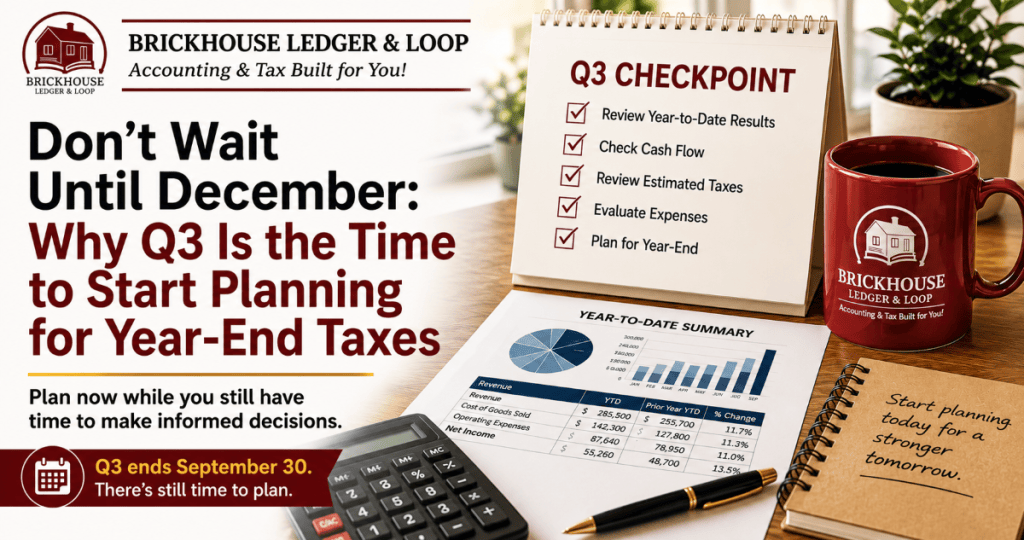
For many small business owners, year-end tax planning doesn’t happen until the end of the year.
December arrives. The books get pulled together. The tax professional starts asking questions. The business owner discovers how profitable the business actually was—and then starts wondering whether something could have been done differently. By then, some planning opportunities have already become decisions about what happened rather than decisions about what can still be done.
With Q3 coming to a close, there is still time to look at where your business is headed and make informed decisions before the year ends.
Your Tax Position Is Already Taking Shape
By the end of September, most businesses have nine months of actual financial activity behind them. That’s valuable information.
Your year-to-date financial statements can tell you:
- How much revenue you’ve generated
- Where your expenses are trending
- Whether profitability is increasing or declining
- How much cash the business actually has available
- What customers still owe you
- What you owe vendors and lenders
- How much you’ve already paid toward estimated taxes
- Whether major purchases or other unusual transactions have affected the business
None of this guarantees what the final tax return will look like. But it gives you something far more useful in September than waiting until tax preparation season: Time to make informed decisions.
December Is Not the Best Time to Discover What Happened
There’s a significant difference between tax preparation and tax planning. Tax preparation looks backward. Tax planning looks forward.
Once December arrives, much of the year’s business activity is already behind you. Your tax professional can calculate the results and identify the applicable tax treatment, but there is considerably less opportunity to change the underlying business activity that produced those results.
Profit Still Isn’t the Same Thing as Cash
If you’ve read our recent Conference Room article, this may sound familiar. A business can be profitable and still have considerably less cash available in its bank account.
Why?
Because the Profit & Loss Statement doesn’t tell the entire story.
Customer payments may still be sitting in Accounts Receivable. Loan principal payments reduce cash without appearing as an expense on the Profit & Loss. Equipment purchases can consume significant cash while being accounted for differently than ordinary operating expenses. Owner draws can reduce available cash without reducing business profit.
That’s why year-end planning shouldn’t focus exclusively on a projected tax bill. You also need to understand what the business can actually afford to do. A tax decision that looks attractive on paper isn’t necessarily a good business decision if it creates a cash-flow problem.
What Should You Review Before Entering Q4?
A useful Q3 review doesn’t have to be complicated. Start with the information already available in your accounting system.
1. Year-to-Date Revenue
- Compare current revenue with the prior year and consider what you reasonably expect during the fourth quarter.
- Is revenue ahead of expectations, or behind?
- Are there significant contracts, projects, or customer payments expected before year-end?
2. Year-to-Date Expenses
- Look for significant changes in operating expenses and whether costs are increasing faster than revenue.
- Have there been unusual expenses?
- Are there recurring expenses that should be reviewed before another year begins?
3. Current Profitability
Your year-to-date Profit & Loss provides an important starting point for understanding where the business may finish the year. But don’t simply look at the bottom-line number. Understand why you’re there.
4. Cash Position
- How much cash is actually available?
- And how much of that cash is already committed to payroll, vendors, debt payments, taxes, or other obligations?
A profitable business can still find itself cash constrained.
5. Accounts Receivable
- How much money do customers still owe you?
- Are those receivables likely to be collected?
- Are older balances becoming a concern?
Reported revenue and available cash can tell very different stories when a significant portion of sales remains uncollected.
6. Estimated Tax Payments
Review what has already been paid and compare it with your current projected tax position.
If your business income has changed significantly during the year, this is something worth discussing with your tax professional before the year ends, rather than discovering a substantially different position when the return is prepared.
7. Equipment and Other Major Purchases
- Have you purchased equipment or are you considering a significant purchase before year-end?
- Don’t make the purchase solely because someone says it will “save taxes.”
- First ask the more important question:
Does the business actually need it, and can the business afford it?
Tax treatment is only one part of a business decision.
8. Loans, Owner Draws, and Other Cash Activity
Review transactions that affect cash but don’t necessarily affect taxable business profit in the same way as ordinary operating expenses. Understanding these items is essential when evaluating your financial position and making year-end decisions.
Your Books Need to Be Current Before Planning Can Be Useful
Bookkeeping becomes more than simply recording transactions when the information it produces can actually support business decisions. If your books are several months behind, your financial statements aren’t giving you a current picture of the business and year-end planning becomes much harder.
Good tax planning starts with good financial information. Your bookkeeping system doesn’t need to be complicated, but the information needs to be:
- Current
- Accurate
- Properly classified
- Reconciled
- Understandable
- Useful for decision-making
That’s the difference between bookkeeping as a recordkeeping exercise and accounting as a management tool.
What are my numbers telling me now — while I still have time to respond?
With Q3 coming to a close, now is a good time to review your financial statements, cash position, estimated tax payments, and year-end expectations. You don’t necessarily need to make a decision today. But you should have enough reliable information to know which questions need to be answered before December arrives.
The Ledger Tells Your Story
At Brickhouse Ledger & Loop, we believe your financial statements should do more than satisfy a recordkeeping requirement.
They should help you understand your business.
The Ledger tells your story. Let’s make sure you understand it.